
Florida homeowners dealing with attic access issues often discover the problem during the hottest months, when a malfunctioning attic stair becomes more than an inconvenience—it becomes a safety concern and an energy liability. With the 2025 Florida Building Code emphasizing stricter energy performance standards, properly functioning attic access points now play a measurable role in maintaining conditioned air separation. Across the state, from coastal communities experiencing salt-laden air to inland areas with intense afternoon storms, attic ladder systems face relentless environmental pressure. Our attic stairs installation and repair services address these region-specific challenges with technical precision developed over 20 years of field experience. Whether you're managing a heritage home in a historic district or a newer construction property, the mechanical integrity of your attic access system directly affects indoor comfort, storage accessibility, and long-term structural protection.
Comprehensive Attic Access Restoration Solutions
Structural Assessment and Hardware Replacement
When folding mechanisms bind or springs lose tension, the entire ladder assembly becomes unreliable. We conduct full structural evaluations that examine frame attachment points, ceiling joist load distribution, and hinge wear patterns. Corroded pivot hardware gets replaced with marine-grade components better suited to Florida's humidity levels, while weakened mounting brackets receive reinforcement that meets current load-bearing standards.
Seal Integrity and Insulation Coordination
Gaps around attic stair frames create measurable energy loss—particularly problematic when air conditioning accounts for substantial utility costs throughout extended cooling seasons. Our restoration process includes weatherstripping replacement, insulated door panel upgrades, and gasket installation that maintains thermal separation between conditioned living spaces and superheated attic environments. This work directly supports HVAC efficiency while preventing moisture migration that accelerates wood rot.
Spring Mechanism Restoration
Spring-assisted ladders depend on precisely calibrated tension to operate safely. Over time, metal fatigue and corrosion compromise lifting assistance, making extension difficult and creating drop hazards during retraction. We restore proper spring function through replacement with corrosion-resistant assemblies, adjusting tension to match the specific ladder weight and user requirements while ensuring smooth, controlled operation through the full range of motion.
Tread and Rail Reinforcement
Wooden ladder sections exposed to attic heat cycles and humidity fluctuations develop stress cracks, split grain, and surface degradation. Our reinforcement services address compromised treads before they become structural failures, replacing damaged sections with properly treated lumber and reinforcing attachment points where repeated load stress concentrates. Metal rail systems showing rust penetration receive treatment or replacement based on remaining material integrity.
Complete Installation for New Access Points
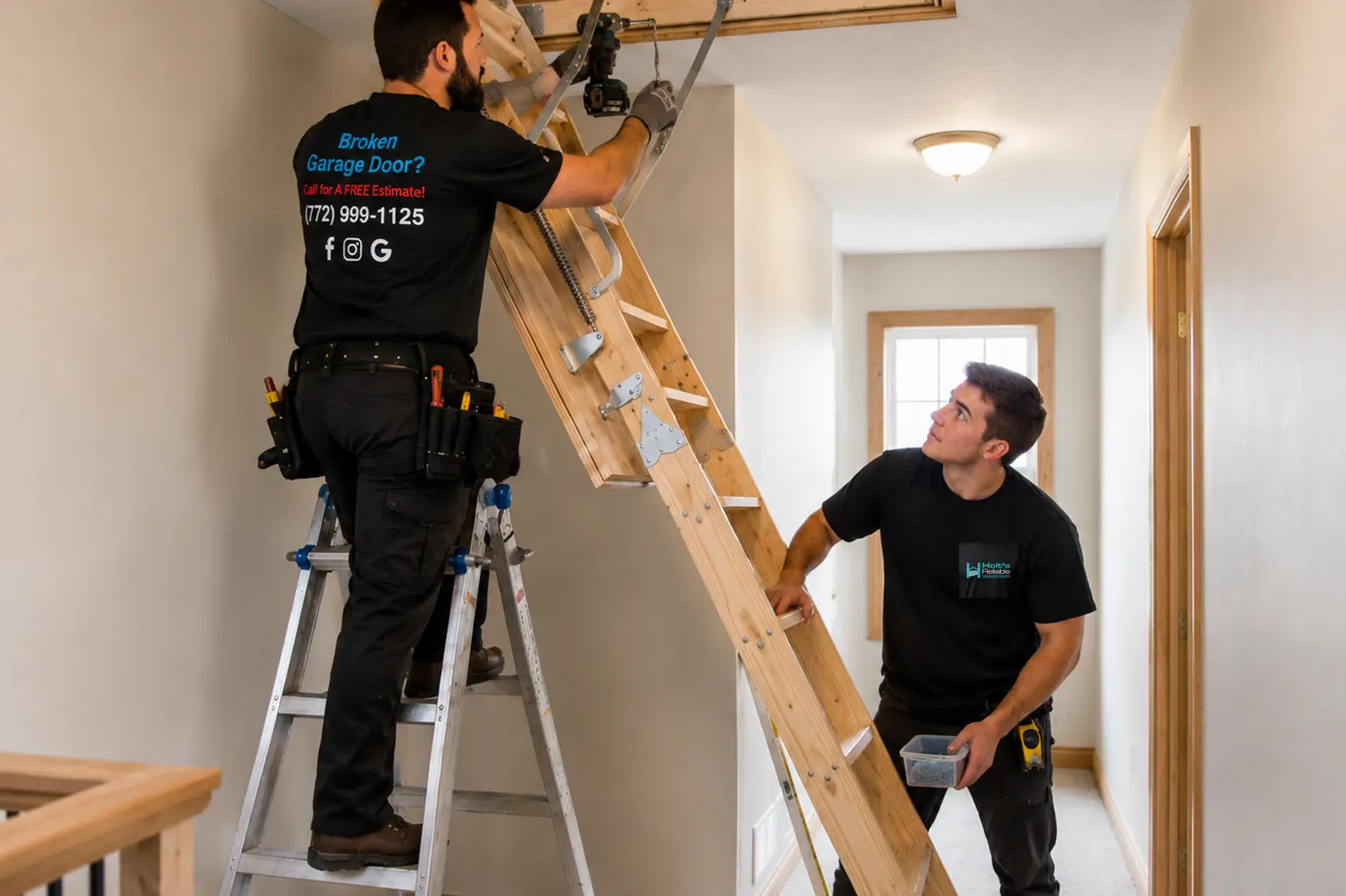
Adding attic stair installation where none previously existed requires precise ceiling modification, joist header construction, and load path engineering. We coordinate these installations with attention to electrical routing, HVAC ductwork clearance, and finished ceiling integration—ensuring the new access point functions reliably while maintaining structural and aesthetic standards appropriate to your home's design.
Understanding Florida's Impact on Attic Access Systems
Humidity and Coastal Corrosion Factors
The state's persistent humidity creates conditions where metal components corrode faster than in arid climates, while coastal proximity introduces salt particles that accelerate oxidation on exposed hardware. These environmental realities mean that attic ladder repair in Florida demands material selection and protective treatments specifically engineered for tropical and subtropical exposure. Generic replacement parts sourced from national suppliers often lack the corrosion resistance necessary for long-term reliability in our climate.
Thermal Cycling and Material Stress
Attic temperatures regularly exceed 140°F during summer months, while conditioned spaces below remain 75°F—creating a temperature differential that subjects ladder frames and folding mechanisms to continuous expansion and contraction cycles. This thermal stress fatigues metal joints, loosens fasteners, and warps wooden components over time. Our restoration approach accounts for these forces, using fastening techniques and materials that accommodate movement without compromising structural integrity.
Professional Restoration Process
Initial System Evaluation
Every project begins with a thorough operational assessment examining spring tension, hinge function, frame attachment security, seal condition, and tread integrity. We document load-bearing adequacy, measure clearance dimensions, and identify any code compliance concerns that affect safety or performance. This diagnostic phase establishes the restoration scope and identifies underlying issues that superficial repairs would leave unresolved.
Coordinated Repair Execution
Restoration work proceeds systematically—addressing structural deficiencies before cosmetic concerns, replacing hardware before adjusting mechanisms, and ensuring proper ladder geometry before final tension calibration. Each component receives individual attention within the context of overall system function, with testing performed at multiple stages to verify operational improvement and identify any secondary issues requiring adjustment.
Performance Validation and Homeowner Guidance
Completed installations undergo full-cycle testing under load, verifying smooth extension, stable positioning, controlled retraction, and proper seal engagement. We provide operation guidance specific to the restored system and outline maintenance practices that extend service life—particularly important given Florida's demanding environmental conditions. Documentation includes hardware specifications and adjustment parameters useful for future service needs.
Two Decades of Technical Expertise
Local Knowledge and Standards Compliance
Since establishing operations in Florida, we've developed specialized understanding of how regional conditions affect attic access systems—knowledge that informs material selection, installation techniques, and maintenance recommendations. Our work consistently meets Florida Building Code requirements while addressing practical performance expectations homeowners have for daily-use access systems. This combination of regulatory compliance and functional reliability distinguishes professional restoration from temporary fixes.
Warranty Protection and Transparent Communication
We stand behind completed work with clear warranty coverage that protects both parts and labor, providing accountability that reflects our confidence in restoration quality. Throughout every project, communication remains straightforward—explaining what we find, why specific approaches make sense for your situation, and what realistic expectations should be for system longevity given your home's specific conditions and usage patterns.
Practical Guidance for Florida Homeowners
Understanding when attic ladder service becomes necessary helps prevent minor issues from developing into safety hazards or costly emergency situations. If your ladder requires excessive force to extend or retract, that resistance typically indicates spring fatigue, hinge corrosion, or frame misalignment—all conditions that worsen with continued use. Similarly, visible gaps around the closed door panel signal seal failure that's allowing conditioned air loss and potentially introducing moisture into attic insulation. Addressing these symptoms promptly through professional assessment prevents accelerated deterioration and maintains the energy efficiency your HVAC system depends on.
The relationship between attic access condition and overall home performance often surprises homeowners. A poorly sealed attic stair creates a thermal chimney effect, where warm attic air continuously infiltrates living spaces despite insulation elsewhere in the ceiling plane. This infiltration forces air conditioning systems to run longer cycles, increases humidity levels in interior spaces, and can contribute to moisture problems in adjacent ceiling areas. Proper attic stair repair restores the thermal boundary that building science principles rely on for energy-efficient home operation—particularly critical in Florida's climate where cooling costs represent the largest utility expense for most households.
Material selection significantly affects service life in our environment. Aluminum ladder sections resist corrosion better than steel but require different hinge designs to maintain strength. Wooden ladders offer aesthetic advantages but need moisture-resistant treatments and periodic inspection for grain separation. When considering new attic stair installation or complete replacement, discussing material options with experienced technicians helps match the system to your specific conditions—whether that involves coastal salt exposure, unusually high attic temperatures, or particular weight capacity requirements for storage access.
Timing restoration work strategically can prevent emergency situations. If you notice operational difficulty increasing gradually, that progression indicates mechanical wear that will eventually cause complete failure—often at the least convenient moment. Scheduling professional evaluation while the system still functions allows planned restoration rather than urgent response, typically resulting in better outcomes and more cost-effective solutions. For homeowners throughout Florida managing aging attic access systems, proactive attention to performance changes represents practical stewardship that protects both safety and home value. Our technical team remains available to discuss specific concerns and provide guidance tailored to your home's particular circumstances and access requirements.
Schedule Your Attic Access Assessment
Whether you're dealing with a ladder that's become difficult to operate, planning new attic access installation, or simply concerned about gaps and energy loss around your existing system, professional evaluation provides clarity and direction. Our team serves communities throughout Florida with the same technical standards and transparent approach that's defined our work for 20 years. Contact us to arrange an assessment of your attic access system—we'll explain what we find, outline practical solutions, and provide straightforward guidance that helps you make informed decisions about your home's functionality and efficiency.